
India’s FII paradox: $9.2 billion into IPOs, $39 billion pulled from listed stocks
FIIs poured $9.2 billion into Indian IPOs but pulled $39 billion from listed stocks as domestic investors absorbed the selling.
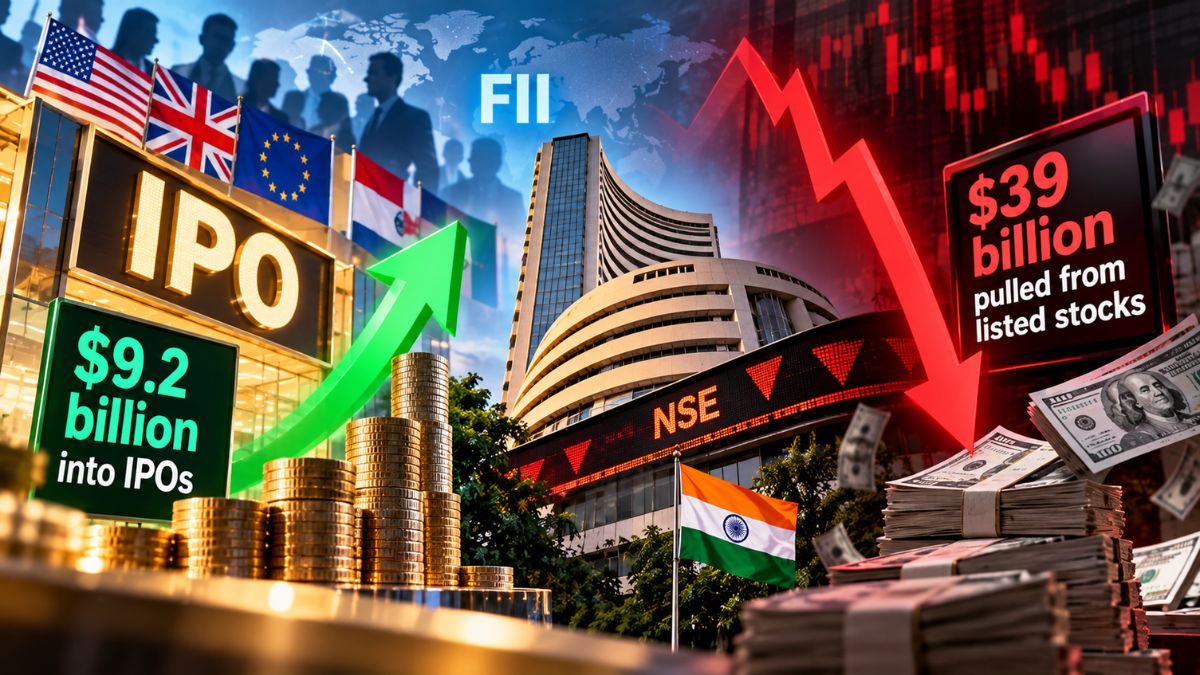
Foreign institutional investors (FIIs) poured $9.2 billion into India’s primary market over the 12 months to September 2026, even as they pulled $39 billion out of shares traded on stock exchanges. The divergence captures the split in foreign capital flows, with new share issuances attracting money while the broader listed market faces sustained selling.
According to JM Financial’s FII Monthly Flow Tracker – Sep’26, dated October 8, FIIs sold Indian equities worth Rs 39,660 crore in September alone, while domestic institutional investors (DIIs) bought Rs 76,030 crore worth of shares. The Nifty fell 6.1% during the month, after declining 1.2% in August.
“Over the last 12 months, Indian primary markets raked in FII net inflows of INR 855bn (USD 9.2bn), while secondary markets suffered FII net outflows of Rs 3,648 bn ($39bn),” JM Financial said.
The contrast comes as foreign ownership of Indian equities continues to decline and domestic institutions take a larger share of the market. Although primary issuances are still attracting foreign capital, the much larger withdrawals from listed shares have weighed on overall flows.
FIIs invested a net Rs 85,500 crore in India’s primary market over the 12 months to September, while withdrawing Rs 3.65 lakh crore from the secondary market. In September, primary-market inflows stood at Rs 9,310 crore, compared with Rs 12,620 crore in August. Secondary-market outflows, meanwhile, reached Rs 48,970 crore, reversing net inflows of Rs 10,230 crore in the previous month.
The September selling followed two consecutive months of net buying by FIIs. Foreign funds sold equities on most trading days during the month, with selling intensifying towards the end.
“In September 2026, FIIs were net sellers to the tune of INR 396.6bn (USD 4.1bn), while Nifty fell 6.1% MoM after a 1.2% fall in Aug’26. FIIs turned net sellers in Sep’26 after being net buyers for two consecutive months,” JM Financial said.
The figures distinguish money raised by companies through primary issuances from transactions in already-listed shares. Foreign participation in new offerings has remained positive over the past year, but it has not offset the selling in the secondary market.
Domestic funds have been buying as overseas institutions reduce their exposure. DIIs purchased Rs 76,030 crore worth of equities in September, while FII selling reached Rs 39,660 crore. The gap between the two flows helped absorb some of the pressure on the market.
The ownership data show how the balance has changed over time. FII ownership fell to 13.8% of total Indian equities at the end of September, from 14.2% in August and 19.9% in September 2016. DII ownership reached 18.9% in June 2026, and domestic institutions have held a larger share of Indian equities than foreign institutions since December 2024.
“DII ownership as a % of total Indian equities has risen over the years to 18.9% in June 2026. Since December 2024, DIIs have held a greater share of Indian equities than FIIs,” JM Financial said.
FII assets under custody in Indian equities stood at Rs 66.2 lakh crore at the end of September, down 6% from Rs 70.4 lakh crore in August. The decline in foreign ownership has unfolded alongside the rise in domestic institutional holdings.
Banking, financial services and insurance recorded the largest sectoral FII outflow in September, at $1.37 billion. Oil and gas followed with $715 million, while autos saw $647 million in net selling. Telecom, metals, fast-moving consumer goods and power also recorded outflows.
Pharmaceuticals and services were among the few sectors to attract foreign capital, receiving net inflows of $220 million and $243 million, respectively.
Source: JM Financial; September 2026 net flows.
JM Financial also noted that no sector saw FIIs turn into net buyers in September after being net sellers in August. Compared with the previous month, foreign funds turned net sellers in banking and financial services, autos, metals, consumer durables, capital goods and information technology.
Banking and financial services, pharmaceuticals, autos, capital goods, and oil and gas remained the five largest sectors in FII portfolios. Together, they accounted for about 60% of foreign assets under custody in India.
Banking and financial services made up 30.2% of FII assets under custody in September, up from 30.1% in August. Pharma’s share rose to 8% from 7.7%, while capital goods increased to 7.4% from 7.3%. Auto holdings declined to 7.5% from 7.8%, and oil and gas remained unchanged at 6.5%.
“These five sectors make up ~60% of FII assets in India; FII shareholding increased sequentially in BFSI, Pharma and Capital Goods, whereas it decreased in Auto and was flat in Oil & Gas in Sep’26,” JM Financial said.
The portfolio data show that these sectors continue to account for much of foreign institutional exposure, even as monthly flows turned negative in several of them. Pharma stood out in September, attracting fresh money while foreign funds sold shares in banking and financial services, autos, capital goods and oil and gas.
India’s weight in the MSCI Emerging Markets Index dropped to 10.7% in September, from 11.3% in August and 15.2% in September 2025. The decline has coincided with lower FII ownership of domestic equities.
In its comparison of foreign flows across selected countries, JM Financial recorded net outflows of about $4.1 billion from India in September. Japan and South Korea also saw substantial outflows, while Brazil recorded net inflows.
The report’s data point to two parallel trends: foreign capital continues to enter India through primary-market issuances, but overseas institutions are withdrawing far more money from listed shares. Domestic institutional buying has provided an important counterweight, although the Nifty’s September decline shows that it has not prevented a broad market fall.
Disclaimer: This article provides factual analysis only and is not, and should not be construed as, an offer, solicitation, or recommendation to buy or sell securities. Investors must conduct their own independent due diligence and seek advice from a SEBI-registered financial advisor.
Related Stories

Sensex Today | Stock Market LIVE Updates: Sensex down 540 pts, Nifty below 22,650; Nestle, Max Healt
Sensex Today | Stock Market LIVE Updates: Indian benchmark indices were trading lower with Sensex down 298.90 points or 0.41 percent at 73,410.79, and the Nifty down 117.60 points or 0.52 percent at 22,693.75. About 1423 shares advanced, 2284 shares declined, and 173 shares unchanged. Except Realty, all other sectoral indices were trading in the red.
Jio Platforms IPO subscribed 3.05 times on Day 1, attracts bids worth over ₹67,500 crore
The Jio Platforms IPO was subscribed 3.05 times on its first day, attracting over ₹67,500 crore in bids, led by strong demand from Qualified Institutional Buyers.

Reliance Jio IPO subscription status day 1: QIB, NII, Retail, Employees, RIL Shareholders; category wise investor detail
Jio Platforms’ IPO was subscribed 3.16 times on its first day, led by strong institutional demand. QIBs subscribed 9.42 times, while NIIs subscribed 1.68 times, employees 1.36 times, RIL shareholders 1.46 times and retail investors 0.73 times. The offer was open until October 23.