Nasdaq sell-off extends; Semiconductor ETF posts worst week in 18 months while Cboe VIX jumps
The sell-off seen on Wall Street has taken the market's fear gauge or the Cbox Volatility Index (VIX) past the mark of 22, for the first time since June, and market participants expect that to go much higher in the near-term.
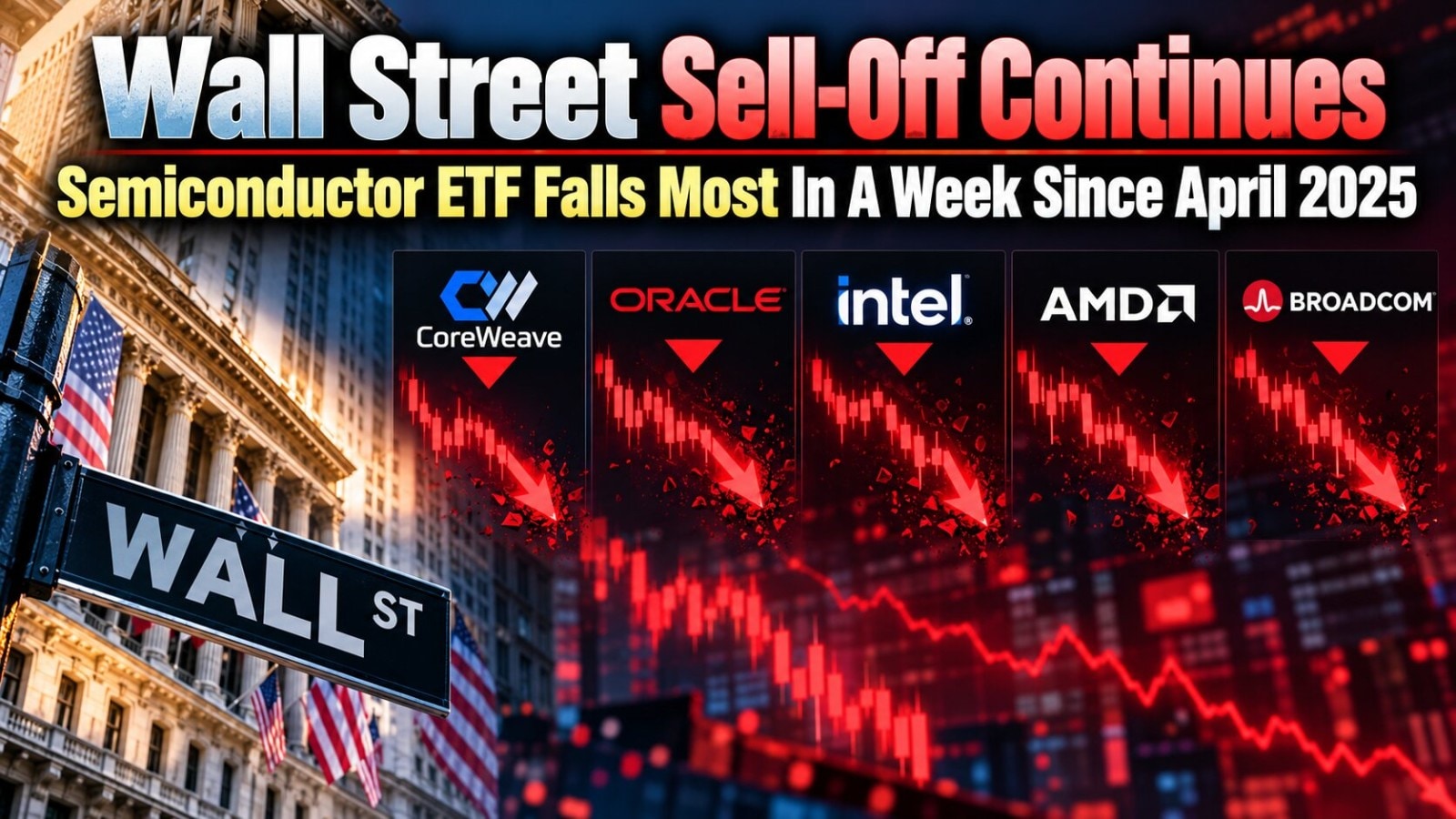
Benchmark indices on Wall Street had another down day on Friday, October 16, as AI and semiconductor-linked stocks continued to see investor exits, while a rise in crude oil prices further soured sentiment.The Dow Jones ended 175 points lower on Friday, outperforming its tech-heavy peers S&P 500 and Nasdaq, and also managing to post a weekly advance of 0.7%. The S&P 500 ended 1.1% lower, while the Nasdaq Composite declined 2.1%. The chip stocks-heavy Nasdaq 100 index ended the session with losses of 2.5%.For the week, the Nasdaq ended 4% lower, marking its worst weekly drop since June.
The S&P 500 also posted a 2% weekly loss. Fears of competition from China and the struggles over debt repayments of companies engaged in massive data center buildouts, dragged the VanEck Semiconductor ETF down 3% on Friday and 10% for the week, the most it has falling weekly since April 2025.Chipmakers were down for the eighth straight day, their longest losing streak since 2008. Shares of AMD, Broadcom, Intel were down between 4% to 6% on Friday, while memory chip makers Sandisk, Western Digital and Seagate fell between 7% to 7.5% overnight.
Oracle Corp. shed another 5% and is now nearing a 52-week low.CoreWeave, the main trigger behind the recent sell-off, fell another 11% on Friday, taking its week-to-date loss to 25%. The company's total debt has now risen to $51 billion.The sell-off seen on Wall Street has taken the market's fear gauge or the Cbox Volatility Index past the mark of 22, for the first time since June, and market participants expect that to go much higher in the near-term.Jensen Huang, the CEO of Nvidia, the world's most valuable company, continues to believe that the AI benefits will soon outweigh the concerns of investors."It’s going to be transformative. It’s going to impact in a very positive way every single industry and every single country.
There’s no question it will continue, and we’re at the beginning of that," Huang told Bloomberg during an interview in Berlin.Analysts suggest that the market debate has shifted from not just how large AI can become, but how large an investment will be needed further to realize the ultimate goal of becoming profitable.Cathie Wood of ARK Investment Management, compared CoreWeave to Coinbase, whose bonds had also come under pressure initially but the company benefitted from the growth of the crypto industry in the long run. For CoreWeave, she believes that investing in the company will payoff as the fund also added the stock during this week's rout.Another reason why sentiments were soured on Wall Street was the sharp jump seen in crude oil prices, where Brent jumped to $110 a barrel overnight as Iran escalated attacks in the Strait of Hormuz while Ukraine and Russia continued to attack each other's energy infrastructure, triggering further supply concerns.
Related Stories

HDFC Bank vs Axis Bank: Both shares recover after Q2 sell-off; which banking stock offers higher upside? Check targets
HDFC Bank and Axis Bank shares have rebounded since October, putting both lenders back in focus. Axis Bank posted stronger quarterly profit growth, while HDFC Bank delivered healthy lending growth and improved asset quality.

UPL likely to revise February 2026 corporate restructuring plan soon: Exclusive
An update on the reorganisation has been widely viewed by market participants and brokerages as a key near-term catalyst for the UPL stock.
Nifty Bank at all time high; 3 stocks need up to 2,200% rise to revisit peaks! -
Ashika Institutional Equities said the key determinants of sector performance in H2FY27 would be banks' ability to sustain deposit mobilisation following the Q2 FCNR(B)-led inflows.