
India to give above-average market returns in next 2 years: Devina Mehra
BS BFSI Insight Summit 2026| Stock Market Prediction: Devina Mehra, founder and CMD of First Global, suggested investors diversify their portfolio with global exposure as India accounts for less than 3 per cent of global market capitalisation.
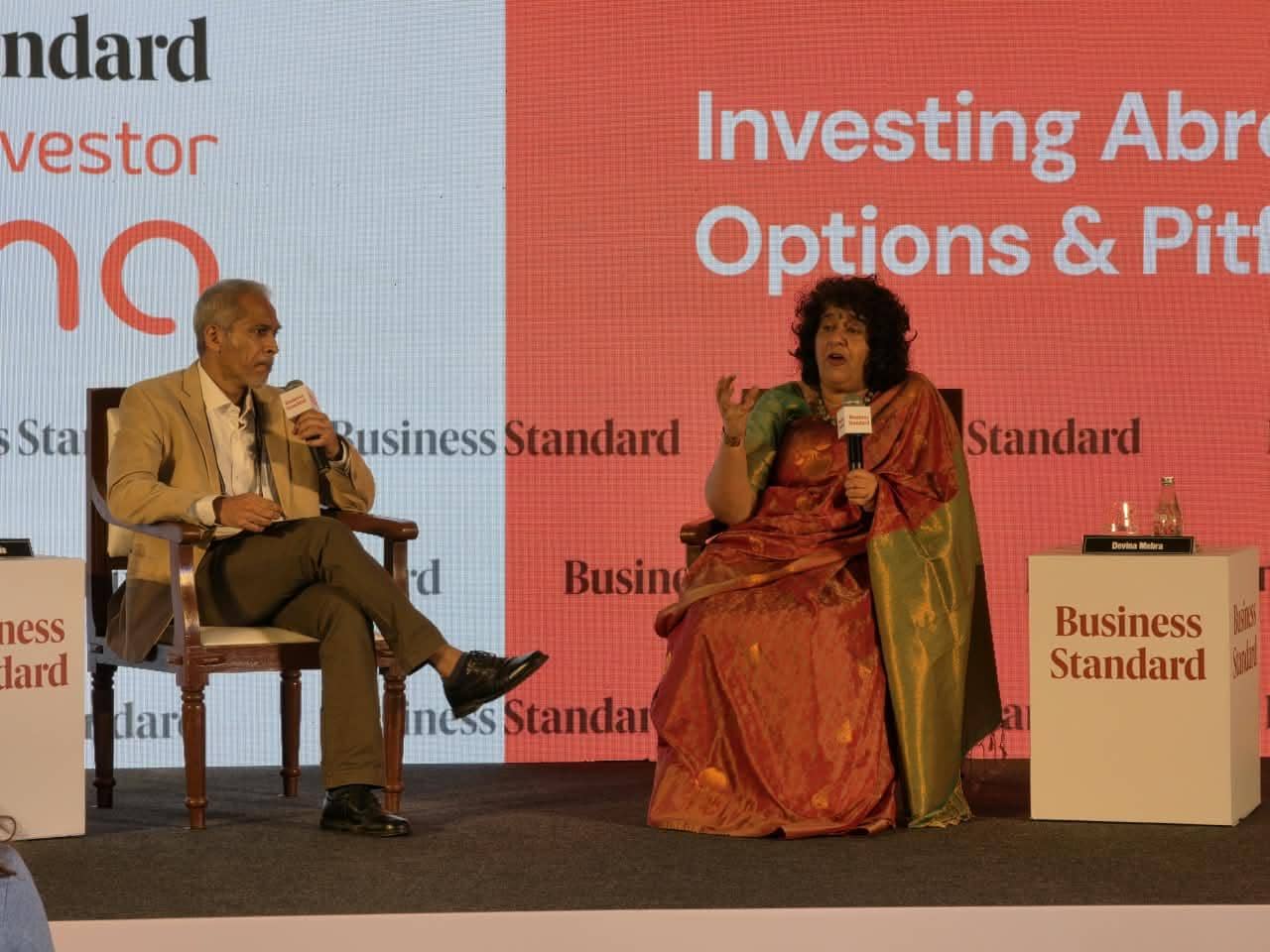
Devina Mehra, founder and CMD of First Global, expects Indian equities to deliver above-average returns over the next two years after a prolonged phase of consolidation. Speaking at the Business Standard BFSI Insight Summit 2026’s Smart Investor Arena on Tuesday, Mehra said investors should diversify their portfolios geographically rather than remain fully invested in domestic markets. “My bet on global investing is not because I have a negative view of India.
India has not done well for 2 years, essentially remained flat. In the past, when Indian markets have been flat for two years, the next years' returns have been in the range of 5 to 55 per cent, averaging about 25 per cent,” she said. “Probability-wise, the Indian markets will do better than average (in the next two years),” Mehra added.
Notably, Indian markets have remained in a phase of consolidation over the past two years, with the benchmark Sensex and Nifty 50 declining around 7 per cent and 6 per cent, respectively. READ MORE: Money best way to buy your freedom; gain choices in life: Ankur Warikoo “When sentiment is very buoyant, when money making appears very easy, as was the case in 2024, the probability is that next period returns will be below normal. When your head is screaming, get out of the market, the next period returns are going to be above normal,” Mehra, who is the author of ‘Money, Myths and Mantras’, said.
She suggested investors diversify their portfolio with global exposure as India accounts for less than 3 per cent of global market capitalisation. “There is no logical reason why 90-100 per cent of your assets should be in India,” she said, adding that the other consideration is rupee depreciation. According to Mehra, if she had put ₹1 lakh in Indian markets the day she had started working, it would have become ₹1.5 crore today.
But in the global markets, it would have become ₹6.8 crore. READ MORE: BFSI sector must lead infra and manufacturing funding, says Shaktikanta Das “For most investors, I would recommend allocating at least 30-40 per cent of their portfolios to global investments over time. Otherwise, you risk ignoring the impact of rupee depreciation,” she mentioned.
“No market performs well forever. The only certainty in investing is that themes change. Sectors, asset classes, countries, smallcap and largecap stocks, value and growth strategies -- everything rotates,” she said, and quickly noted that around 80-85 per cent of her own portfolio has been invested globally.
“The trick in equity markets is that nobody can tell you what will happen in 1 year. Do asset allocation; never have 100 per cent in equity. Have money there (in equity) which you don’t need for 7-8 years.
You might change the stocks, but don’t keep tinkering with allocation,” she said. On AI investments, Mehra said that she has “no doubt that the next book on financial bubbles will have a chapter on AI.” “AI investment is all in very fast depreciating assets. If this goes burst, it may not be of value for the next 1-2 years,” she said. “SpaceX will be the poster child of how the bubble peaked, not just on the valuation front, but people have given so much money with no voting rights.” READ MORE: ₹3 crore retirement corpus can be enough for many Indians: Neha Nagar
Related Stories

AI relief fails to lift legacy IT stocks as earnings worries weigh
The Indian IT sector has seen a rollercoaster of activity, where mid-sized companies have outperformed their larger peers recently. Increased deal bookings are promising, yet slow revenue growth due to client indecision lingers. The emergence of AI technology brings both new possibilities and pricing pressures for classic services. To sustain their margins in this shifting landscape, companies are honing their operational efficiency.

YES Bank files SC review plea over AT-1 bonds: What does it mean for investors after stock's 15% rebound?
YES Bank has asked the Supreme Court to review its October 15 ruling against the write-down of ₹8,415 crore in AT-1 bonds. The move follows a bondholders’ trustee’s contempt petition seeking restoration of the bonds. The ruling has weighed on the bank’s capital outlook and share price.

Sensex falls 319 points, Nifty slips below 25,200: What dragged Dalal Street today?
The Sensex and Nifty snapped their three-day gaining streak on Friday, falling 319 points and 155 points, respectively, as crude oil prices rose and selling pressure hit several sectors. Hitachi Energy, Amber Enterprises and Eicher Motors were among the notable gainers, while Tata Motors PV, Grasim, Muthoot Finance and Manappuram Finance declined.